Moderna galerija’s Archives Department has systematically collected, processed, preserved, published, and provided access to data on and documentary material related to 20th- and 21st-century visual art since its establishment in 1971. The Archives Department collects data on and material related to exhibitions staged in Slovenia, exhibitions of Slovenian artists abroad, exhibition venues and other spaces for the production and presentation of visual art, 20th- and 21st-century visual artists in Slovenia and Slovenian artists abroad, and writers on 20th- and 21st-century visual art.
The data on exhibitions we are interested in are the titles, the dates of opening and closing, venues, locations, exhibition character and type, organizers, whether the exhibition traveled, the exhibiting artists, curators, display designers, publications and printed materials, reception in the media, purchases of artworks for collections, and exhibition-related events.
We also collect data on artists, such as their first and last names, pseudonyms, changes of name, date and place of birth/death, education, studios, employment, travels, public works, participation in art colonies and symposia, bibliographies, participation in exhibitions, works in collections, etc.
Through systematic and continuous work, we compile and curate:
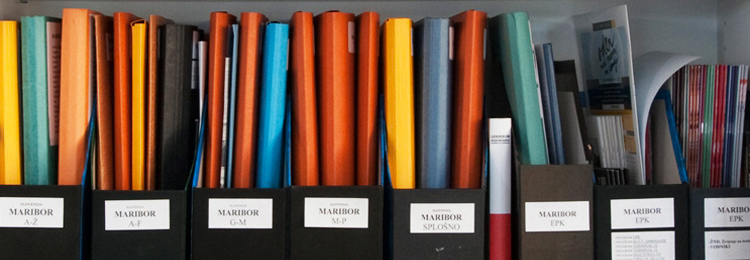
– an archive of Moderna galerija proper (archival and documentary material concerning the work of the institution, i.e., its management and staging of exhibitions);
– an archive of artists (short biographies, correspondence and other records);
– an archive of invitation leaflets;
– an archive of posters;
– an archive of Questionnaires – Organizer;
– an archive of Questionnaires – Artist;
– legacies, such as Rihard Jakopič’s correspondence, Gaber’s legacy, Miha Maleš’s legacy, part of the archive of curator Igor Zabel, and other collections;
– a newspaper library concerning Slovenian visual artists and exhibition venues (a collection of newspaper clippings, photocopies of articles, reviews in journals, and various visual materials reaching back as far as the 1940s). The newspaper library contains more than 80 linear meters of material and is updated daily.
The data on the materials are entered into the RazUme system daily.

RazUme is designed for the systematic recording, classification, structuring, displaying, and
interlinking of data on 20th- and 21st-century visual art in Slovenia. It enables methodologically consistent, verified, and source-based data processing about artists, exhibitions, exhibition venues, publications, bibliographies, awards, public works, and events. Due to its extensive statistics, structure and connectedness, it represents one of the key research and documentation infrastructures for the field of Slovenian modern and contemporary art. The material and data are used by academics, art historians, curators, artists, students, and others in research, exhibition staging, and publishing and study purposes.
The renovation of the system was completed in 2026. The renovated system is based on a new data model and brings advanced options for searching, filtering, sorting, grouping, and exporting data, independent online access to the system, and a bilingual user interface (in Slovenian and English). Compared to the previous version, it is faster and has a significantly greater capacity, it enables processing a larger volume of data and brings new functions, better search options, and the statistical display of key indicators. RazUme further includes e-service researcher access, which allows users to search for and access data and materials online independently.
Data from the RazUme system is exported daily to the European-art.net platform, a European network of contemporary art archives. The platform connects art archives across Europe and enables a unified search across partner databases and access to data on artists, their work, and related materials, such as photographs, texts, and other documentary sources.
RazUme is also connected to the Slovenian culture portal within the eKultura platform, a national information platform for the digitization of and wider access to cultural content in the Republic of Slovenia. The e-Kultura project is a comprehensive ecosystem to present Slovenian culture to the Slovenian and international publics, encouraging connections among creators, cultural institutions, and users.
The renovation of the system has allowed for the preservation of more than three decades of systematically collected data, and the introduction of a modern solution for more efficient data management, processing, and access.
LINKS